The comics industry has never been short of big publishers, established characters, major franchises and highly recognizable brands. From superhero universes to manga-inspired properties and long-running newspaper strips, readers today have more comics available to them than ever before. Yet alongside this increasingly crowded mainstream market, independent comics continue to find audiences and create opportunities for creators who may not fit within traditional publishing structures.
Independent comics occupy a different space within the larger comics ecosystem. They are often created with smaller budgets, fewer people and limited distribution compared with books released by major publishers. But that lack of scale can also give independent creators something extremely valuable: creative freedom. Without having to build every project around an established character or a commercially proven formula, creators can experiment with unfamiliar genres, personal stories, unusual art styles and subjects that larger publishers may consider difficult to market.
This freedom is one of the reasons the independent comics scene continues to matter. A creator can develop an original character, publish a short comic, test it directly with readers and gradually build an audience around it. The process does not necessarily require waiting for a large publishing company to approve the concept. In an environment where digital publishing, crowdfunding, conventions and direct sales have become increasingly important, the distance between creator and reader has become smaller.
A Different Route Into Comics Publishing
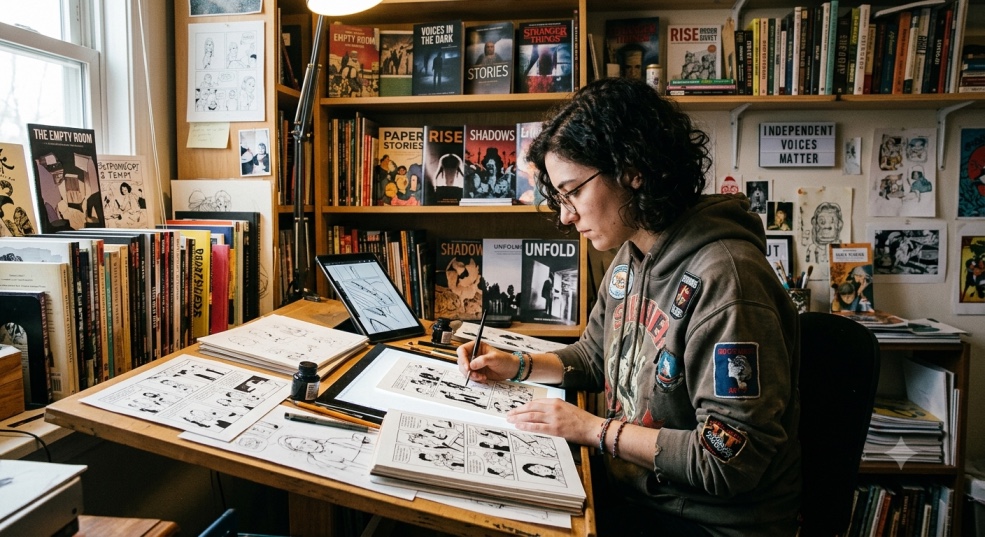
For many creators, independent publishing is not simply an alternative to mainstream comics; it is the first practical route into the industry. New writers and artists often face the same problem: publishers want creators with experience, while creators need opportunities to gain that experience. Independent comics can provide a space where they can develop their storytelling, visual language and publishing skills through actual projects.
This is particularly relevant in markets where the comics ecosystem is still developing. A creator working outside the established publishing system may have to handle several responsibilities at once, including writing, artwork, editing, lettering, printing, promotion and distribution. Although this can be challenging, it also gives creators a much clearer understanding of how comics function as a complete publishing product.
The result is a diverse range of work that might otherwise never reach readers. Some independent comics are highly experimental, while others deliberately follow familiar genres such as horror, science fiction, crime, fantasy or superheroes. What connects them is not necessarily their style, but the fact that the creators have greater control over what they want to make and how they want to present it.
Small Publishers Can Take Bigger Creative Risks
Independent publishers also play an important role in this ecosystem. A smaller publisher may not have the financial resources of a major comics company, but it can sometimes take chances on projects that would be difficult to justify within a larger commercial structure.
For readers, this can make the independent comics market particularly interesting. A mainstream publisher might need a project to appeal to a very large audience before investing heavily in it. A small publisher, meanwhile, may be able to build a business around a much narrower audience. A comic aimed at horror enthusiasts, experimental-comics readers or fans of a particular artistic style can survive without becoming a mass-market phenomenon.
That does not mean independent publishing is easy. Printing costs, distribution, marketing and discoverability remain major challenges. In many cases, creators have to do much of the promotional work themselves, while smaller publishers have limited budgets for advertising and retail expansion. The existence of creative freedom therefore comes with a different set of responsibilities and risks.
Conventions Have Become Important Discovery Spaces
Comic conventions and independent-comics events have also become important parts of this ecosystem. For smaller creators, conventions can provide something that traditional retail distribution often cannot: direct access to readers.
A creator can display a self-published comic, talk to potential readers, collect feedback and sell copies without going through several layers of distribution. These events can also create connections between creators, publishers, artists and readers. For someone who is still building a career, meeting another creator or publisher at an event can sometimes be as valuable as selling copies.
This direct relationship changes the way comics can be discovered. Instead of finding a book only because it has a prominent position in a bookstore or because a major publisher has invested heavily in marketing it, readers can discover comics through conversations, creator tables, recommendations and online communities.
For the independent creator, that relationship can become the foundation of a long-term audience.
The Internet Has Changed the Equation
The growth of digital platforms has further reduced some of the traditional barriers to publishing. Social media can allow creators to show artwork, announce projects and communicate directly with readers. Webcomics can introduce characters and stories before a physical edition is produced, while crowdfunding platforms can help creators test whether an audience is willing to financially support a project.
Digital tools have also lowered the technical barrier to production. Lettering, page layout, editing and promotional design can be handled with software that was not easily available to independent creators in previous decades. Printing itself has also become more flexible, with smaller print runs making it possible to produce physical comics without necessarily committing to a huge initial quantity.
However, easier publishing does not automatically mean easier discovery. The same internet that gives creators access to global audiences also puts thousands of competing projects in front of those audiences. Independent creators therefore face a new problem: not simply producing a comic, but making sure readers can find it.
Original Ideas Still Need Visibility
One of the biggest challenges for independent comics is discoverability. A good comic can exist without receiving meaningful attention if it is buried beneath hundreds of other releases.
This is where comics journalism, reviews, creator interviews, conventions and specialist communities can make a difference. Independent work benefits from having spaces where readers can discover something beyond the biggest publishers and most heavily promoted franchises.
For comics websites and publications, covering independent creators is therefore more than simply filling a news category. It can become part of the industry’s documentation. A creator interview, review or profile can create a permanent record of a project that might otherwise disappear from public attention after its initial release.
The same applies to independent publishers. Their catalogues may contain important experiments, new characters and emerging talent, but those projects can remain invisible unless someone actively documents and discusses them.
India Has Its Own Opportunity
India’s comics ecosystem makes this discussion particularly relevant. The country has a long history of comics publishing, but the contemporary market includes a much wider range of creators and publishers than the names most commonly associated with Indian comics history.
Independent creators are working across genres, languages and formats, while smaller publishers and collectives are experimenting with new ways of producing and distributing comics. Social media and online communities have made it easier for these creators to find readers, but the market is still fragmented.
That fragmentation creates both a challenge and an opportunity. There is no single platform through which every Indian comics project is discovered. Readers may encounter a creator on Instagram, a publisher at a convention, a comic through an online store or a new release through word of mouth. Without consistent documentation, many of these projects can become difficult to find later.
A stronger ecosystem of comics journalism, reviews, interviews, databases and creator profiles can help connect these separate parts of the industry.
Independent Does Not Automatically Mean Better
It is also important not to romanticize independent comics. Being independent does not automatically make a comic more creative, more original or better than a commercially published book. Independent creators can produce excellent work, but they can also produce work that suffers from weak editing, inconsistent artwork, production problems or limited storytelling experience.
The value of independent comics lies more in the opportunities they create than in an assumption that every independent project is superior. They expand the range of voices and ideas available to readers. Some projects will succeed commercially, some will remain niche, and others may simply serve as important learning experiences for their creators.
That variety is healthy for the medium because experimentation often happens at the edges before it becomes part of the mainstream.
The Future May Be More Connected Than Divided
The relationship between independent and mainstream comics is not necessarily a competition in which one side must replace the other. In reality, creators frequently move between different parts of the industry. An artist may begin with self-published work, collaborate with a small publisher and eventually work on a major licensed property. Another creator may spend years in mainstream comics before returning to creator-owned projects.
These movements show that the comics industry is not made up of completely separate worlds. Ideas, creators and audiences move between them.
Independent comics therefore remain important because they provide space for experimentation, new talent and original intellectual property. They also give readers opportunities to discover stories that would be unlikely to appear through the most commercially predictable publishing routes.
In a crowded comics market, that diversity matters. The future of comics will not be shaped only by the largest publishers or the biggest characters. It will also be shaped by creators working with limited resources, small publishers taking calculated risks and readers willing to look beyond the most visible releases.
For the comics industry to grow, those smaller voices need not replace the mainstream. They simply need enough space to be seen, read, discussed and remembered.