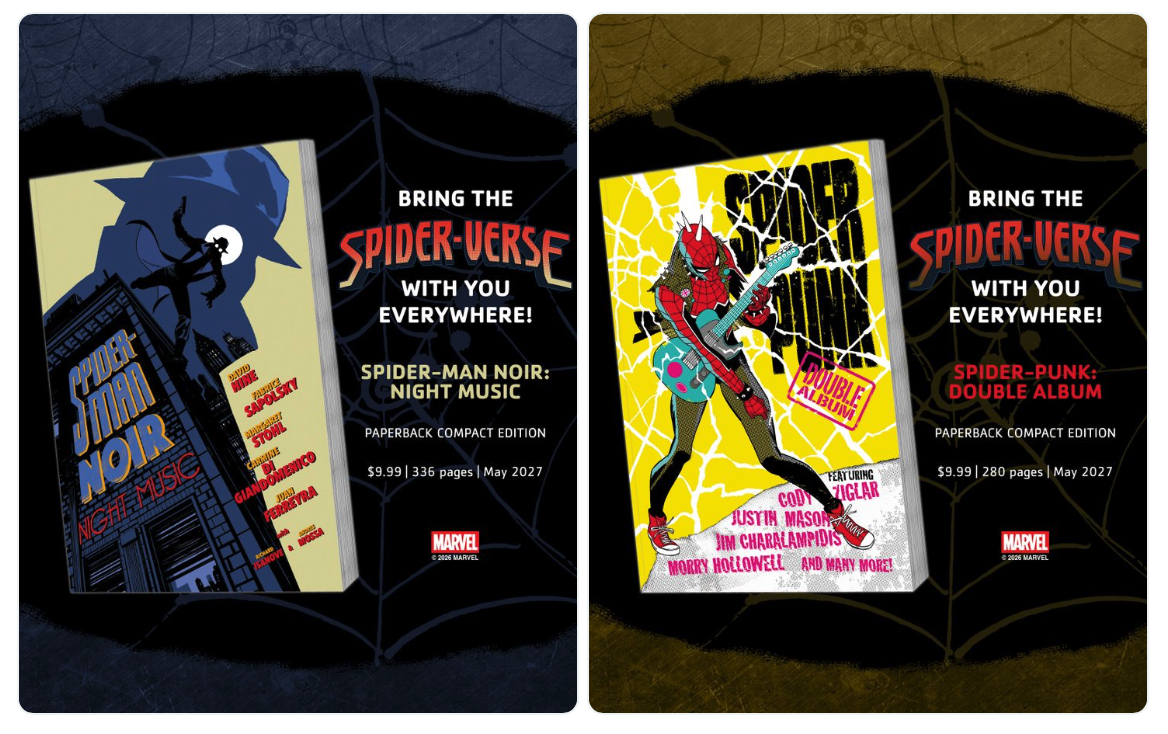
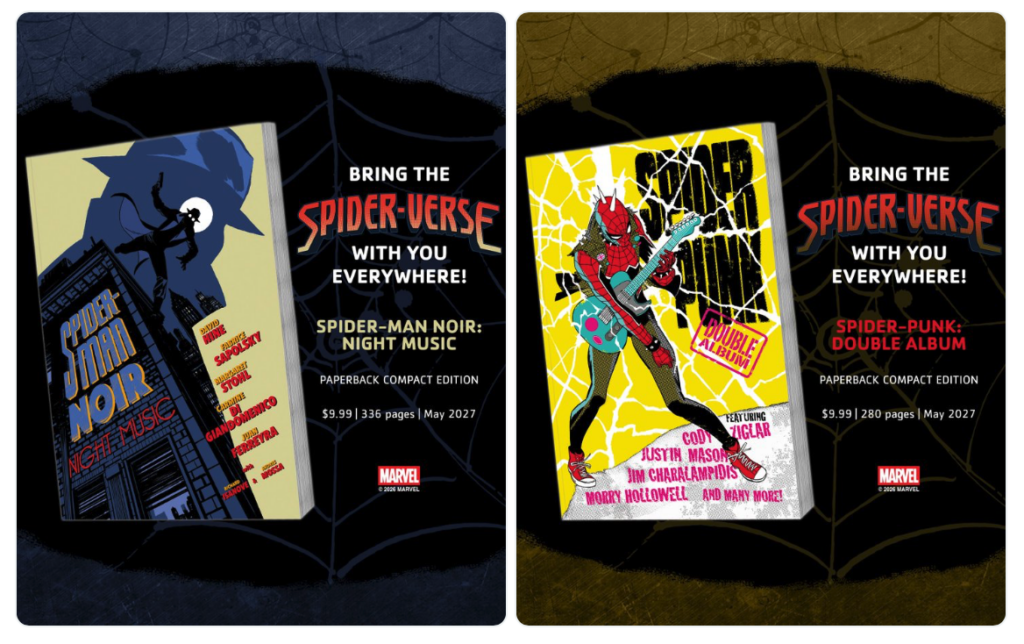
Marvel is expanding its Compact Comics publishing initiative with new volumes centred on Spider-Man Noir and Spider-Punk, adding two alternate versions of Spider-Man to a format designed to make selected stories more accessible to readers.
The new books were reported on September 25, 2026, as Marvel continues to expand its budget-friendly Compact Edition line. The initiative has focused on collecting stories in smaller-format trade paperbacks, giving readers another way to access material from Marvel’s extensive catalogue.
At first glance, another collection of Spider-Man stories may not appear particularly unusual. Marvel publishes a huge number of Spider-Man books every year.
But the Compact Edition strategy is interesting because of what it says about the modern comics market.
The Problem of a Huge Back Catalogue
One of the biggest advantages of a company such as Marvel is also one of its biggest challenges.
There is an enormous amount of material available.
Spider-Man alone has decades of stories, multiple ongoing series, alternate universes, crossover events and different interpretations of the character.
For an existing reader, that history can be exciting.
For a new reader, it can be intimidating.
Where should someone start?
Which stories are important?
Does a reader need to understand years of continuity before opening a particular collection?
Publishers have experimented with different solutions to this problem, including new #1 issues, relaunches, collected editions and simplified entry points.
Compact Editions represent another approach.
Why Spider-Man Noir?
Spider-Man Noir is particularly suited to a collection strategy because the character already exists as a distinct interpretation of Spider-Man.
The Noir version moves the familiar concept into a darker alternate setting. Instead of simply presenting another Peter Parker adventure within the mainstream Marvel universe, the character operates within a different aesthetic and storytelling framework.
That makes the material easier to market as its own experience.
A reader does not necessarily need to begin with decades of mainstream Spider-Man comics.
The same applies to Spider-Punk.
Spider-Punk and the Multiverse Audience
Spider-Punk represents another direction for the Spider-Man concept.
The character became widely recognisable through the larger Spider-Verse phenomenon, which introduced audiences to multiple versions of Spider-Man and demonstrated how flexible the central concept could be.
That flexibility is valuable to Marvel.
Instead of relying entirely on one version of the character, the company can publish stories built around different interpretations, aesthetics and audiences.
The result is a Spider-Man publishing line that can include traditional superhero stories alongside alternative versions of the character.
Compact Editions as an Entry Point
The most interesting part of Marvel’s Compact Edition strategy may be its potential relationship with new readers.
Comics publishers face a recurring problem: the medium has an enormous history, but that history can create barriers to entry.
A new reader does not necessarily want to purchase dozens of individual issues before understanding a story.
Collected editions solve part of that problem.
A compact, relatively inexpensive collection can make the decision easier.
Instead of asking:
“Where do I start with Spider-Man?”
a reader can simply choose a character or story that looks interesting.
That changes the role of the collected edition.
It becomes not just a product for existing fans but potentially an introduction to the medium.
The Importance of Format
Format matters more than it sometimes appears.
Readers have different preferences for individual issues, standard trade paperbacks, hardcovers, digital editions and compact collections.
A publisher that offers several formats can reach different groups without necessarily changing the underlying content.
Marvel’s Compact Editions therefore form part of a broader publishing strategy rather than simply being another collection line.
The question is whether the format can successfully convert curiosity into regular readership.
What It Means for Comics Publishers
The strategy also has implications beyond Marvel.
Indian publishers and independent comics creators face a similar challenge, although at a different scale.
A reader may be interested in a new character but hesitate to spend money on an unfamiliar series.
A clearly packaged first volume, affordable edition or self-contained story can reduce that barrier.
This is particularly relevant for indie comics, where discoverability is often one of the biggest challenges.
The Marvel example shows how publishers can use format and packaging to make a large catalogue easier to navigate.
A Different Way to Think About Marvel’s Catalogue
Marvel’s biggest asset is not simply the number of characters it owns.
It is the number of different stories that can be built around those characters.
Spider-Man Noir and Spider-Punk demonstrate how far the basic Spider-Man concept can travel.
The Compact Comics initiative adds another layer to that strategy by changing how readers encounter those stories.
Whether readers choose Noir, Spider-Punk, mainstream Spider-Man or another Marvel character, the underlying publishing objective remains familiar: make the catalogue easier to discover and give readers a reason to pick up another book.
For a company with one of the largest comic-book libraries in the world, that is an ongoing publishing challenge.
The expansion of the Compact Edition line suggests Marvel is continuing to experiment with how that library can reach readers.