
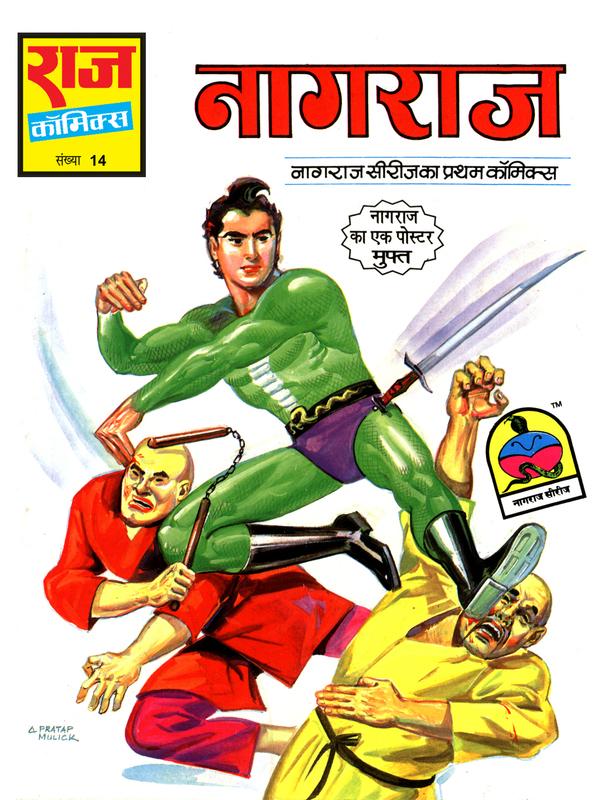
For nearly four decades, Nagraj has remained one of the most recognizable superheroes in Indian comics. First appearing in Raj Comics in 1986, he began as a snake-powered action hero and gradually evolved into something much bigger: a character surrounded by mythology, supernatural powers, recurring villains, elaborate origin stories and connections to one of India’s most ambitious homegrown superhero universes. His journey is not simply the story of a comic-book character becoming popular. It is also a story about how Indian superhero comics evolved over the years.
What makes Nagraj particularly interesting is the way his identity has changed without losing its central idea. The earliest Nagraj stories presented him as a living weapon created through the combination of science and the mythology of snakes. Later stories expanded his origins, introduced ancient serpent kingdoms and supernatural forces, and transformed him into Vishwarakshak Nagraj. Along the way, he became closely associated with Super Commando Dhruva and the larger Raj Comics universe.
So, who exactly is Nagraj? Where did his powers come from? Why was he created as a weapon? How did he become a protector of humanity? And how did a superhero introduced in 1986 develop enough mythology to sustain stories almost forty years later? To understand Nagraj, it is necessary to go back to the beginning.
The Beginning of Raj Comics and the Birth of Nagraj
Raj Comics emerged from Raja Pocket Books, the publishing house associated with Raj Kumar Gupta and his family. Raj Comics’ own current history places its beginning in 1984 with Kanakpuri Ki Rajkumari, while the first issue of Nagraj arrived in 1986. The publisher’s official account describes Nagraj as its first major superhero and says that the character became the foundation of what would eventually develop into the Raj Comics superhero universe.
The idea behind Nagraj was particularly suited to the Indian comics market of the time. Rather than simply creating another superhero based on familiar Western conventions, the creators looked toward Indian mythology and folklore. Snakes already occupied a powerful place in Indian cultural imagination through concepts such as Nagas, Ichchhadhari Nagas, venomous serpents and supernatural beings. The result was a superhero whose powers were instantly recognizable as something rooted in Indian storytelling.
Nagraj #14: The First Appearance
Nagraj first appeared in Nagraj GENL-0014 in 1986. Raj Comics’ official character page identifies the debut issue as the first appearance of Nagraj and credits Raj Kumar Gupta and Manoj Gupta with creating the character. The same source identifies Parshuram Sharma as the writer of the debut issue and Pratap Mullick as its illustrator.
The distinction between creation and the creative team of the first comic is important because Nagraj’s credits have sometimes been described differently in different historical accounts. For example, Sanjay Gupta has also been described in media coverage as a co-creator of Nagraj, while Raj Comics’ current official page gives the creation credit to Raj Kumar Gupta and Manoj Gupta. The safest way to describe the history is therefore to distinguish the broader creation of the character from the writing and artwork of the first published story.
Pratap Mullick’s contribution was particularly important because his artwork established the visual identity of the early Nagraj. He remained associated with the character through its formative years, before the artistic direction changed significantly in the mid-1990s.
The Original Origin of Nagraj
Nagraj’s origin is one of the most fascinating parts of his history because it has evolved over time. According to Raj Comics’ current official character history, Nagraj was born in the kingdom of Takshaknagar, as the son of King Takshakraj and Queen Lalita. A sinister plot led to the infant being believed dead and cast into a river, after which he was rescued by mystical serpents. He eventually came into the hands of Professor Nagmani, who transformed him into a weapon. Baba Gorakhnath later freed him, allowing Nagraj to reject his original purpose and choose the path of protecting humanity.
This version of the origin is considerably more elaborate than the basic premise with which the character initially entered the comics market. Academic research into Nagraj’s mythology has also noted that the character’s origin was subsequently expanded and reinterpreted, particularly through later stories such as Khazana. This makes Nagraj unusual even among long-running superheroes: his past itself became part of the mythology that successive writers could revisit and reinterpret.
Professor Nagmani and the Living Weapon
Professor Nagmani is central to the earliest version of Nagraj’s story. Rather than becoming a superhero by accident, Nagraj was deliberately turned into a weapon. Nagmani’s purpose was to exploit Nagraj’s extraordinary biological and supernatural abilities for destructive ends.
This concept gave Nagraj an unusual starting point. He was not born with a heroic mission. He was given a purpose by someone else. The important part of his story is therefore not simply the acquisition of superpowers, but the rejection of the purpose for which those powers were created.
Baba Gorakhnath and the Choice of a New Path
Baba Gorakhnath becomes the figure who changes Nagraj’s destiny. After confronting the forces controlling him, Gorakhnath frees Nagraj and helps him break away from the role of a weapon. From that point onward, Nagraj begins using his powers to fight crime and protect people.
That transformation is arguably the emotional foundation of the character. The superhero identity of Nagraj is not simply something he receives at birth. It is something he chooses.
This is also why his origin continues to work even after the mythology around him became much more complicated. Beneath all the serpent kingdoms, supernatural powers and giant crossover events, the central idea remains simple: a being created to destroy chooses instead to protect.
From Snake Mythology to Superhero Powers
Nagraj’s powers were designed around the idea of the serpent, but they were never limited to a single ability. His original identity was built around venom, snake control, extraordinary physical strength and his ability to use serpents as weapons. Over the years, the list of his abilities became considerably larger.
Raj Comics currently lists several core powers, including control over millions of snakes, super strength, venom breath, hypnotism and shape-shifting. Other references to the character also describe abilities such as regeneration, invisibility, telepathy, poison attacks and microscopic shape-shifting snakes associated with his body.
The Snakes Inside Nagraj
One of the most distinctive ideas in Nagraj’s mythology is that his body contains enormous numbers of microscopic snakes. These snakes can be used in combat and can perform different functions depending on the situation.
This concept helped distinguish Nagraj from superheroes whose powers were based on a single physical ability. His snake powers could be expanded almost indefinitely, allowing writers to introduce new variations without abandoning the character’s basic identity.
It also made Nagraj visually distinctive. Snakes emerging from his body, his venom-based attacks and his ability to control serpents became some of the most recognizable elements of his comics.
Ichchhadhari Powers and Shape-Shifting
The idea of the Ichchhadhari Naga is another important influence on Nagraj. Shape-shifting gives him an additional connection with Indian serpent mythology while also providing a classic superhero ability.
Instead of being limited to one physical form, Nagraj can alter his appearance and use his body in ways that ordinary human characters cannot. This combination of mythology and superhero mechanics became one of the defining characteristics of the character.
The Early Nagraj: Action, Terrorism and Larger-Than-Life Villains
The earliest Nagraj stories were strongly action-oriented. He fought criminals, terrorists and dangerous villains while using his extraordinary snake-based abilities. Contemporary accounts of Raj Comics describe Nagraj as a superhero who fought terrorists using mythical snake powers, while his adventures increasingly took him into larger and more spectacular conflicts.
This was significant because Nagraj appeared at a time when Indian popular culture was increasingly responding to contemporary concerns such as terrorism and violent crime. Instead of placing the character entirely inside a mythological setting, Raj Comics combined mythology with modern action storytelling.
That combination helped Nagraj feel both familiar and new.
Nagpasha, Nagina and Other Early Enemies
Professor Nagmani was only the beginning of Nagraj’s growing gallery of enemies. Characters such as Nagpasha, Nagina, Miss Killer, Shakoora, Thodanga and Nagdant became associated with the wider Nagraj mythology. Raj Comics’ current official character page continues to list these characters among Nagraj’s notable enemies.
As these villains accumulated, Nagraj’s world gradually became more than a series of isolated superhero adventures. Recurring characters created continuity, while old enemies could return with new motivations and new powers.
The Formative Years: 1986 to the Mid-1990s
The first decade of Nagraj’s existence was essentially the period in which his identity was being established. During these years, the character went through numerous adventures and several artists worked on his comics.
Available historical records list artists including Sanjay Ashtpure, Pratap Mullick, Chandu, Milind Misal and Vitthal Kamble during this period. According to historical accounts, this initial run continued until the mid-1990s, after which a major change in the visual and narrative direction of Nagraj took place.
This period is important because it established the basic formula that made Nagraj popular: a visually striking superhero, snake-based powers, colourful villains, international adventures and a distinctly Indian mythological identity.
But the biggest transformation was still to come.
Anupam Sinha and the Transformation of Nagraj
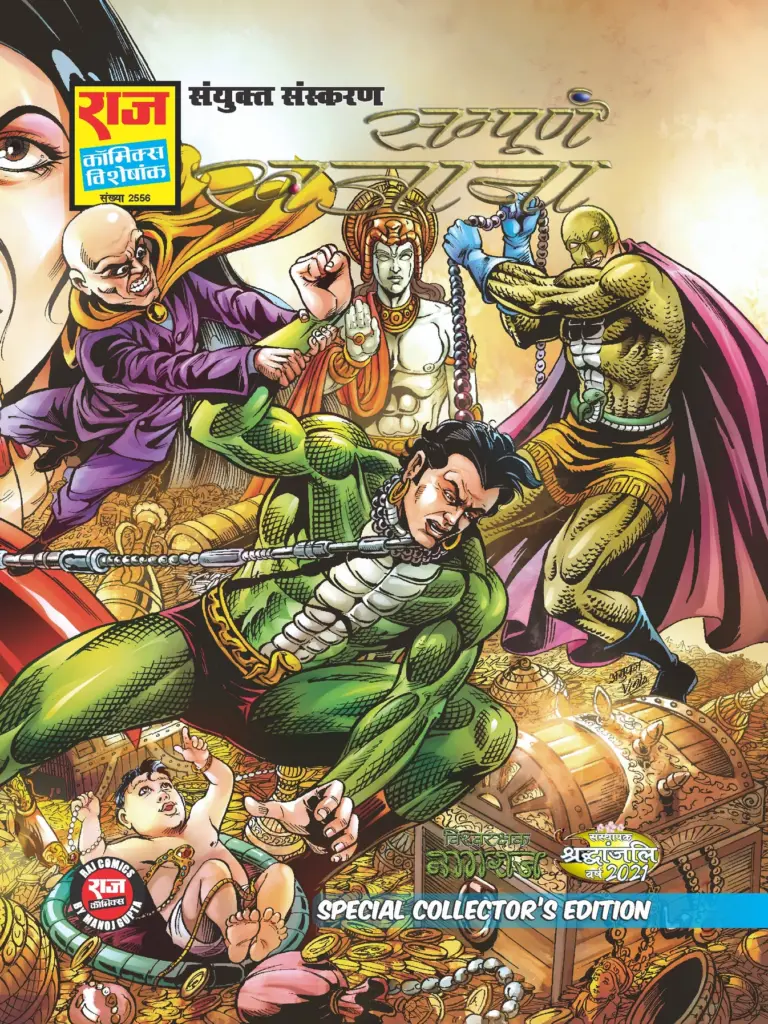
The mid-1990s marked one of the most important turning points in Nagraj’s history. Anupam Sinha became deeply associated with the character, taking over the artistic direction and contributing to the development of a much larger mythology.
Historical accounts place Sinha’s takeover around 1995, beginning with Shakoora Ka Chakravyuh. From this point onward, Nagraj increasingly moved toward longer narratives, more elaborate mythology and a more mature visual presentation.
This was not simply an artist replacing another artist. The character itself was changing.
From Individual Stories to a Larger Mythology
The early Nagraj could usually be understood through individual adventures. Later stories increasingly assumed that the reader was familiar with his past, his enemies and the mythology surrounding him.
That change gave longtime readers much more depth. Nagraj no longer existed only to fight the villain of the month. His world had history.
Ancient civilizations, supernatural forces, serpent mythology, alternate identities and large-scale conflicts became increasingly important. Nagraj was gradually becoming the kind of character whose universe could support stories far beyond the straightforward superhero formula of his debut.
Khazana and the Reinvention of Nagraj’s Past
One of the most important examples of this mythology-building was the Khazana story arc. Later stories attempted to place Nagraj’s existence within a much larger historical and mythological framework.
Academic research on Nagraj specifically identifies Khazana as an important point in the reinvention of his mythology and notes how later stories connected his origin to an expanded mythic history.
This is one reason Nagraj’s history cannot be treated as a completely fixed biography. His origin itself became a storytelling tool.
Why the Origin Kept Changing
Long-running superheroes often accumulate new explanations for old mysteries. Nagraj followed the same pattern, but with an especially Indian approach: instead of merely adding scientific explanations, later stories increasingly connected his history with ancient mythology and serpent lore.
The result was a character whose past became almost as large as his present.
Vishwarakshak Nagraj
As the scale of Nagraj’s stories expanded, so did his role. He was no longer simply a superhero fighting criminals and terrorists. He increasingly became a protector against threats that could affect entire civilizations, worlds and supernatural realms.
This evolution is reflected in the identity Vishwarakshak Nagraj—Nagraj as a protector of the world.
The transformation is important because it represents the second major phase of his character. The first Nagraj was defined by his powers. The later Nagraj was increasingly defined by his responsibility.
From Weapon to Protector
If Nagraj’s origin is read as one continuous character arc, there is a clear progression. First he is created as a weapon. Then he gains freedom. After that he becomes a crime fighter. Eventually he becomes a protector on a much larger scale.
That progression is one of the reasons the character has been able to survive for so long. His mythology keeps changing, but the basic emotional journey remains recognizable.
Nagraj and Super Commando Dhruva
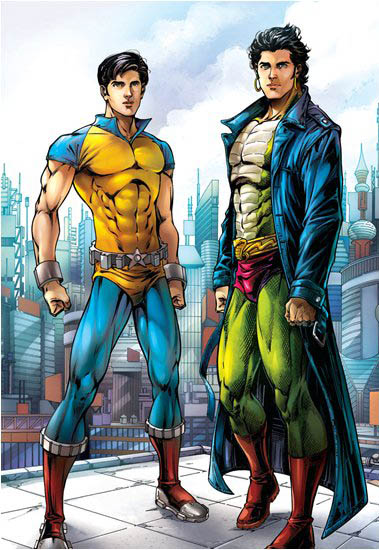
Nagraj’s history cannot be separated entirely from the wider Raj Comics universe. One of the most important relationships in that universe is his connection with Super Commando Dhruva.
Dhruva and Nagraj are very different heroes. Nagraj’s abilities are rooted in supernatural powers, serpent mythology and extraordinary physical capabilities. Dhruva relies much more heavily on intelligence, strategy, scientific knowledge, training and observation.
Their differences make their team-ups particularly effective.
Two Different Ideas of the Indian Superhero
Nagraj represents the supernatural side of the Raj Comics universe, while Dhruva often represents the rational and scientific side. When they appear together, these two approaches can complement each other.
This is one of the reasons their crossover stories became so important to Raj Comics. Their relationship demonstrated that the publisher’s superheroes could exist within one interconnected universe rather than remaining isolated characters.
Nagayan and the Shared Raj Comics Universe
As Raj Comics expanded its universe, stories such as Nagayan pushed the interconnected approach even further.
The importance of such crossovers goes beyond simply putting two popular characters on the same cover. They create a sense that events occurring in one series can have consequences for another. For readers, this turns separate comic-book titles into parts of a larger fictional world.
Nagraj’s position at the centre of several major crossover stories therefore reflects how important the character became to the Raj Comics universe as a whole.
The Mythological Expansion of Nagraj
By this stage, Nagraj’s world had become much larger than the premise of the original 1986 comic. Stories involving ancient forces, serpent civilizations, supernatural beings and large-scale conflicts became increasingly important.
Titles and storylines associated with Nagraj include Khazana, Trifna, Nag Pralay, Nagayan and, much later, the Sarpsatra saga.
This expansion gave writers the freedom to tell very different kinds of Nagraj stories. A single character could now appear in a crime story, a science-fiction adventure, a mythological conflict or a massive crossover.
Nag Pralay and the Larger Threats
Stories such as Nag Pralay represent the period when Nagraj’s adventures increasingly moved toward large supernatural conflicts.
The enemies were no longer necessarily ordinary humans. The scale of danger could involve forces connected with the mythology of Nagas and the supernatural world.
That change made Nagraj’s universe far more ambitious than it had been in 1986.
The Problem With Forty Years of Nagraj
There is an unavoidable consequence of keeping a character alive for four decades: continuity becomes complicated.
Nagraj has gone through different writers, artists, story arcs, identities and interpretations. Some stories expand earlier ideas, some reinterpret them and others place the character in large crossover situations.
For a longtime fan, this complexity can be part of the fun. For a new reader, however, it can be intimidating.
Which Nagraj Is the “Real” Nagraj?
There is no simple answer to this question because the character has been repeatedly expanded and reinterpreted.
The Nagraj of the original 1986 comic and the Vishwarakshak Nagraj of later mythology are recognizably the same character, but their worlds are dramatically different.
This is not necessarily a weakness. It is a normal consequence of long-running superhero storytelling. What matters is that the core identity survives even when the mythology around it becomes more elaborate.
Nagraj Enters the Modern Era
The Indian comics industry changed significantly after the 2000s. Print distribution, retail networks and reading habits all evolved, while digital platforms created new ways for readers to discover older comics.
For Raj Comics, one of the major challenges was keeping characters created in the 1980s relevant to readers who had grown up in a completely different media environment.
Nagraj was particularly well positioned for this because his mythology was flexible enough to accommodate new types of stories.
Nagraj and the Coronavirus Era
The COVID-19 pandemic produced one of the more unusual modern appearances of Nagraj with Nagraj Strikes: The Attack of the Coronaman.
The story demonstrated how an established superhero could be placed into a contemporary context rather than being restricted entirely to his older mythology.
For a character that had already survived several decades, this kind of experiment was significant. It showed that Nagraj could still be used to respond to subjects that were immediately relevant to contemporary readers.
Sarpsatra: Nagraj’s Modern Mythological Saga
One of the most significant modern chapters in Nagraj’s history is Sarpsatra, a five-part saga centred around Nagraj and Tausi.
Raj Comics’ official store describes the complete Sarpsatra collection as a five-comic saga of roughly 200 pages, with Anupam Sinha associated with the story and artwork. The series represents a return to the mythology-heavy, large-scale storytelling that had become one of the defining characteristics of modern Nagraj.
Sarpsatra
The first part establishes the central conflict and places Nagraj and Tausi at the centre of the story.
Sarpdwandwa
The second part continues the confrontation and expands the conflict between the two characters.
Sarpyagya
The third chapter pushes the mythology further and continues the larger narrative surrounding the Nagraj-Tausi conflict.
Sarpyug
The fourth instalment moves the story toward its final stage, increasing the scale and consequences of the conflict.
Sarpkaal
The fifth and final chapter concludes the Sarpsatra saga. It is also particularly significant because Raj Comics presents it as the return of Vishwarakshak Nagraj after a seven-year absence.
This makes Sarpkaal more than simply the conclusion of a five-part storyline. It connects the modern era of Nagraj with one of the most recognizable versions of the character from the mythology-heavy period.
Nagraj in 2026
In 2026, Nagraj remains one of the most important characters in the Raj Comics catalog. The official Raj Comics store continues to carry a substantial range of Nagraj titles and collections, including material connected with Nagayan and Sarpsatra.
That continued presence is significant. Many comic-book characters created during the 1980s disappeared as publishing trends changed, but Nagraj survived because his mythology was repeatedly expanded.
He has been redesigned, reinterpreted and placed into new kinds of stories, yet his fundamental identity has remained intact.
Why Nagraj Still Matters
Nagraj’s importance goes beyond nostalgia.
He represents one of the earliest successful attempts to create a modern Indian superhero whose identity was deeply connected to Indian mythology. His powers were not simply copied from an existing Western superhero template. His entire concept—his name, abilities, enemies and mythology—was built around the cultural idea of the Naga.
That gave Raj Comics something valuable: a superhero who could feel Indian without having to constantly explain why he belonged in an Indian story.
Nagraj’s Real Superpower Is His Mythology
Nagraj’s greatest strength may not actually be his venom, shape-shifting or control over snakes. It is the flexibility of his mythology.
A writer can take him into a crime story, a supernatural adventure, an ancient myth, a science-fiction conflict or a crossover with another superhero, and the character still feels like Nagraj.
Very few Indian comic characters have been given that much narrative room over such a long period.
From 1986 to 2026: The Complete Journey
Nagraj’s four-decade journey can essentially be understood as a transformation from weapon to protector.
He began in 1986 as a powerful snake-based superhero created through the combination of science and serpent mythology. Professor Nagmani treated him as a weapon, while Baba Gorakhnath helped him break free and choose a different path. During the late 1980s and early 1990s, his stories established the character’s powers, enemies and action-oriented identity. In the mid-1990s, the involvement of Anupam Sinha helped transform Nagraj into a more ambitious and mythology-driven character. Later stories expanded his origin, introduced larger supernatural conflicts and established the identity of Vishwarakshak Nagraj. His relationship with Super Commando Dhruva helped connect him to the wider Raj Comics universe, while stories such as Nagayan demonstrated the possibilities of large-scale crossover storytelling.
In the modern era, Nagraj continued to evolve. Contemporary experiments such as Nagraj Strikes: The Attack of the Coronaman showed that the character could still interact with current subjects, while the five-part Sarpsatra saga returned him to the large-scale mythology that had defined much of his later history. Sarpkaal then brought Vishwarakshak Nagraj back into the spotlight.
The Legacy of Nagraj
The story of Nagraj is ultimately much larger than the story of one comic-book superhero.
He represents the period when Indian publishers began creating superheroes who could stand on their own rather than simply imitate characters from elsewhere. He helped establish Raj Comics as one of the most important names in Indian superhero publishing and became one of the central figures around which the Raj Comics universe was built.
But perhaps the most interesting part of Nagraj’s history is the contradiction at the heart of his character. He was created to be a weapon, yet became a protector. He was built around the mythology of snakes, yet evolved into a superhero capable of confronting threats far beyond the world of serpents. He began with relatively straightforward adventures, yet eventually acquired a mythology so large that even longtime readers can discover new layers in it.
That is why Nagraj has survived for almost forty years.
The character has changed because Indian comics have changed. His stories have changed because his readers have changed. His mythology has expanded because Raj Comics kept finding new ways to use the basic idea that made him memorable in the first place.
And after nearly four decades, one thing remains at the centre of his story: Nagraj was given extraordinary power, but it was his choice of what to do with that power that made him a hero.