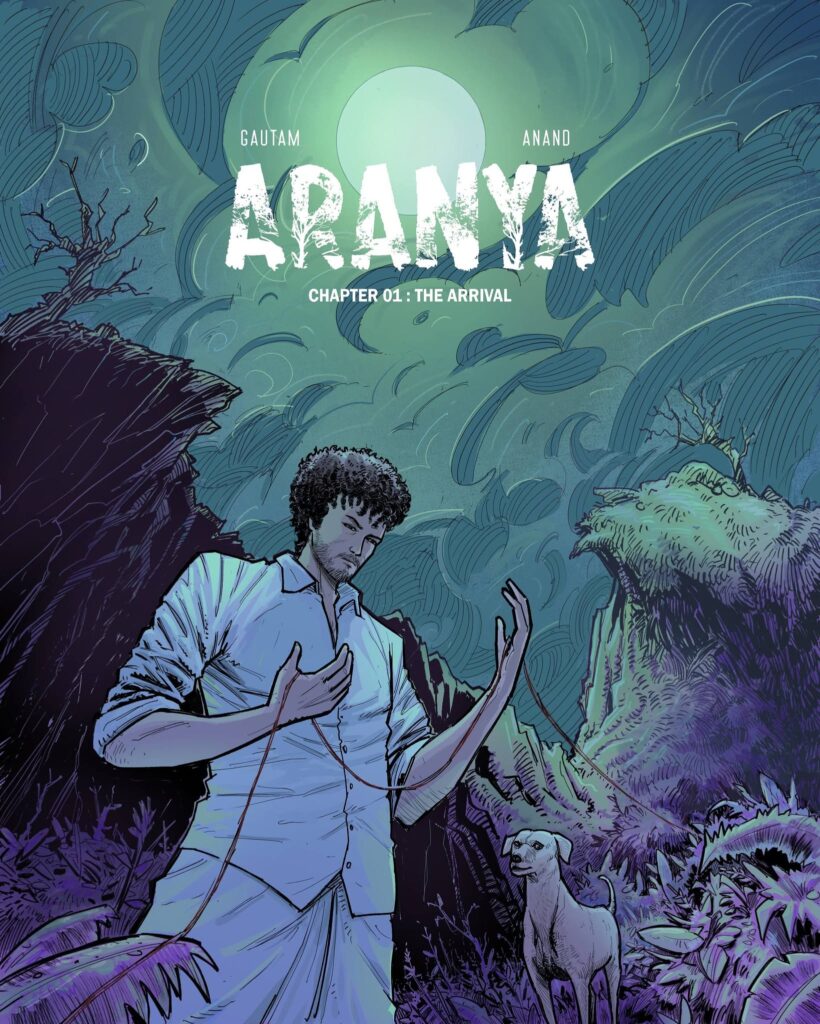
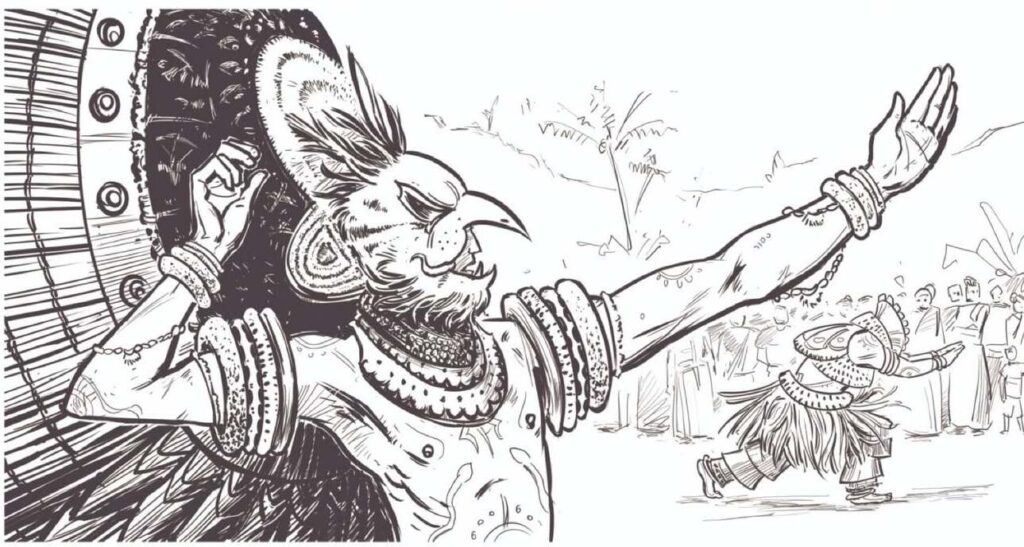
The Indian indie comics landscape is undergoing an incredible phase of experimentation, dark narratives, and original storytelling. Joining this movement, Mad Dog Publications is set to release ‘ARANYA’, an ambitious 3-part limited comic series. The recent reveal of its teaser art and preview pages has already captured the attention of horror, mystery, and comic enthusiasts across the community.
What is the Premise of ‘ARANYA’?
Set along the remote border of Kerala and Tamil Nadu, the story unfolds in a secluded village enveloped by dense, sacred forests.
For generations, the villagers have adhered strictly to ancestral traditions, rituals, and rules surrounding the woods. These ancient protocols were created for two reasons: to protect the sanctuary of the forest, or to shield humanity from an ancient, unknown dread hiding inside it. However, over time, human greed, power, and fear slowly corrupted these sacred customs with deceit and false warnings.
The true conflict erupts when a string of violent, horrific murders grips the peaceful village. As panic spreads, a central mystery takes hold:
Is the ancient forest exacting revenge for a broken pact?
Or is a dark human conspiracy orchestrating these gruesome deaths from the
shadows?
Artwork & Treatment: Folklore Meets Dark Mystery
Created by Gautam and Anand, the saga begins with ‘Chapter 01: The Arrival’. The visuals and artistic direction stand out for several key reasons:
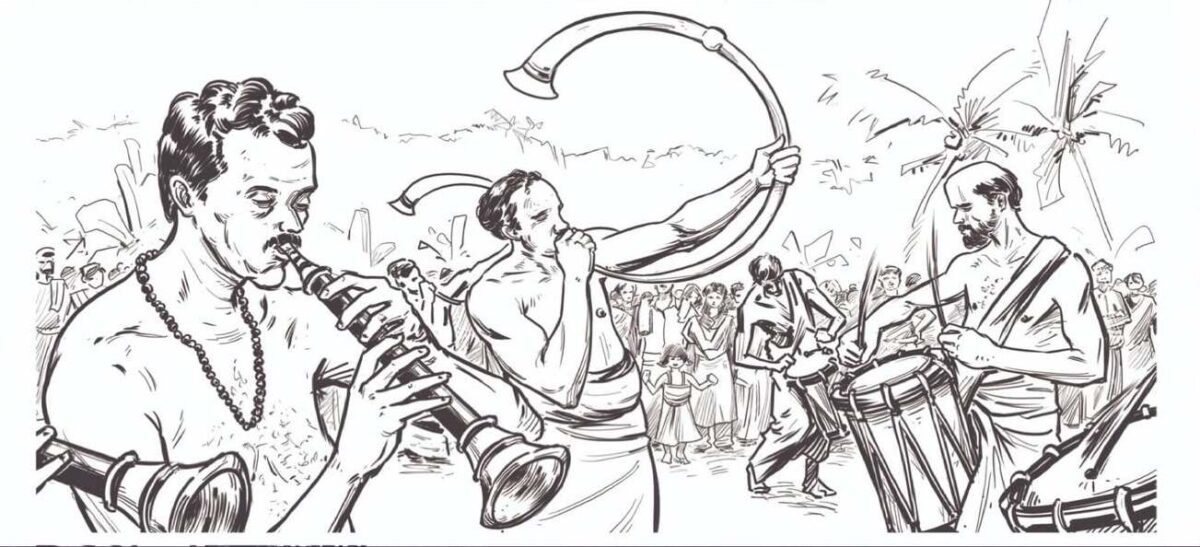
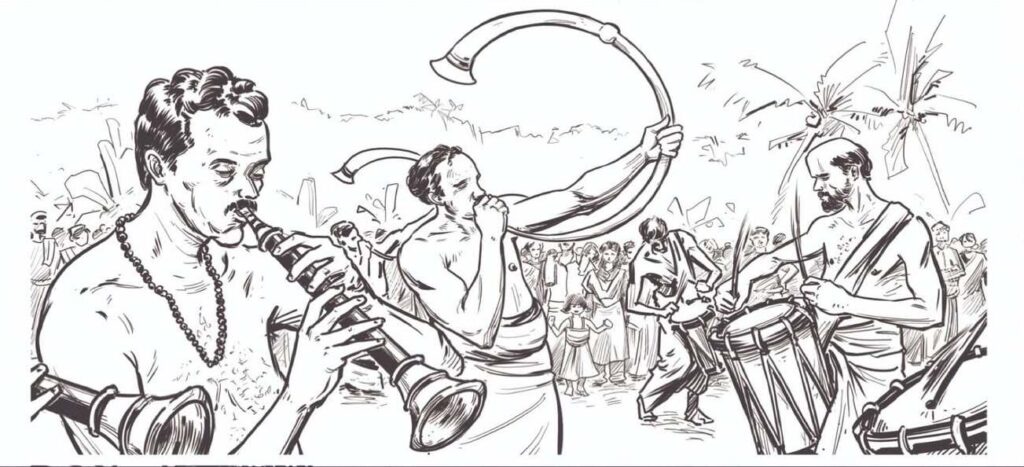
Authentic South Indian Aesthetic: The teaser artwork seamlessly integrates regional culture, traditional instruments (such as the Chenda and Kuzhal), and local ritualistic motifs, giving the world a grounded and eerie sense of place.
Intense and Atmospheric Paneling: From early pencil sketches to finished inked pages, the art establishes a dark, suspenseful tone. The page layouts feature creature designs and dynamic action pacing that keep the tension high.
The ComicsBaaz Take
Whenever Indian comics merge regional folklore with psychological and supernatural horror, the end result is almost always unique and memorable. ARANYA brings a solid, highly engaging concept to the table.
If you are a fan of lore-driven mystery thrillers like Kantara or Tumbbad, this limited series from Mad Dog Publications definitely deserves a spot on your reading wishlist.
The comics industry has never been short of big publishers, established characters, major franchises and highly recognizable brands. From superhero universes to manga-inspired properties and long-running newspaper strips, readers today have more comics available to them than ever before. Yet alongside this increasingly crowded mainstream market, independent comics continue to find audiences and create opportunities for creators who may not fit within traditional publishing structures.
Independent comics occupy a different space within the larger comics ecosystem. They are often created with smaller budgets, fewer people and limited distribution compared with books released by major publishers. But that lack of scale can also give independent creators something extremely valuable: creative freedom. Without having to build every project around an established character or a commercially proven formula, creators can experiment with unfamiliar genres, personal stories, unusual art styles and subjects that larger publishers may consider difficult to market.
This freedom is one of the reasons the independent comics scene continues to matter. A creator can develop an original character, publish a short comic, test it directly with readers and gradually build an audience around it. The process does not necessarily require waiting for a large publishing company to approve the concept. In an environment where digital publishing, crowdfunding, conventions and direct sales have become increasingly important, the distance between creator and reader has become smaller.
A Different Route Into Comics Publishing
For many creators, independent publishing is not simply an alternative to mainstream comics; it is the first practical route into the industry. New writers and artists often face the same problem: publishers want creators with experience, while creators need opportunities to gain that experience. Independent comics can provide a space where they can develop their storytelling, visual language and publishing skills through actual projects.
This is particularly relevant in markets where the comics ecosystem is still developing. A creator working outside the established publishing system may have to handle several responsibilities at once, including writing, artwork, editing, lettering, printing, promotion and distribution. Although this can be challenging, it also gives creators a much clearer understanding of how comics function as a complete publishing product.
The result is a diverse range of work that might otherwise never reach readers. Some independent comics are highly experimental, while others deliberately follow familiar genres such as horror, science fiction, crime, fantasy or superheroes. What connects them is not necessarily their style, but the fact that the creators have greater control over what they want to make and how they want to present it.
Small Publishers Can Take Bigger Creative Risks
Independent publishers also play an important role in this ecosystem. A smaller publisher may not have the financial resources of a major comics company, but it can sometimes take chances on projects that would be difficult to justify within a larger commercial structure.
For readers, this can make the independent comics market particularly interesting. A mainstream publisher might need a project to appeal to a very large audience before investing heavily in it. A small publisher, meanwhile, may be able to build a business around a much narrower audience. A comic aimed at horror enthusiasts, experimental-comics readers or fans of a particular artistic style can survive without becoming a mass-market phenomenon.
That does not mean independent publishing is easy. Printing costs, distribution, marketing and discoverability remain major challenges. In many cases, creators have to do much of the promotional work themselves, while smaller publishers have limited budgets for advertising and retail expansion. The existence of creative freedom therefore comes with a different set of responsibilities and risks.
Conventions Have Become Important Discovery Spaces
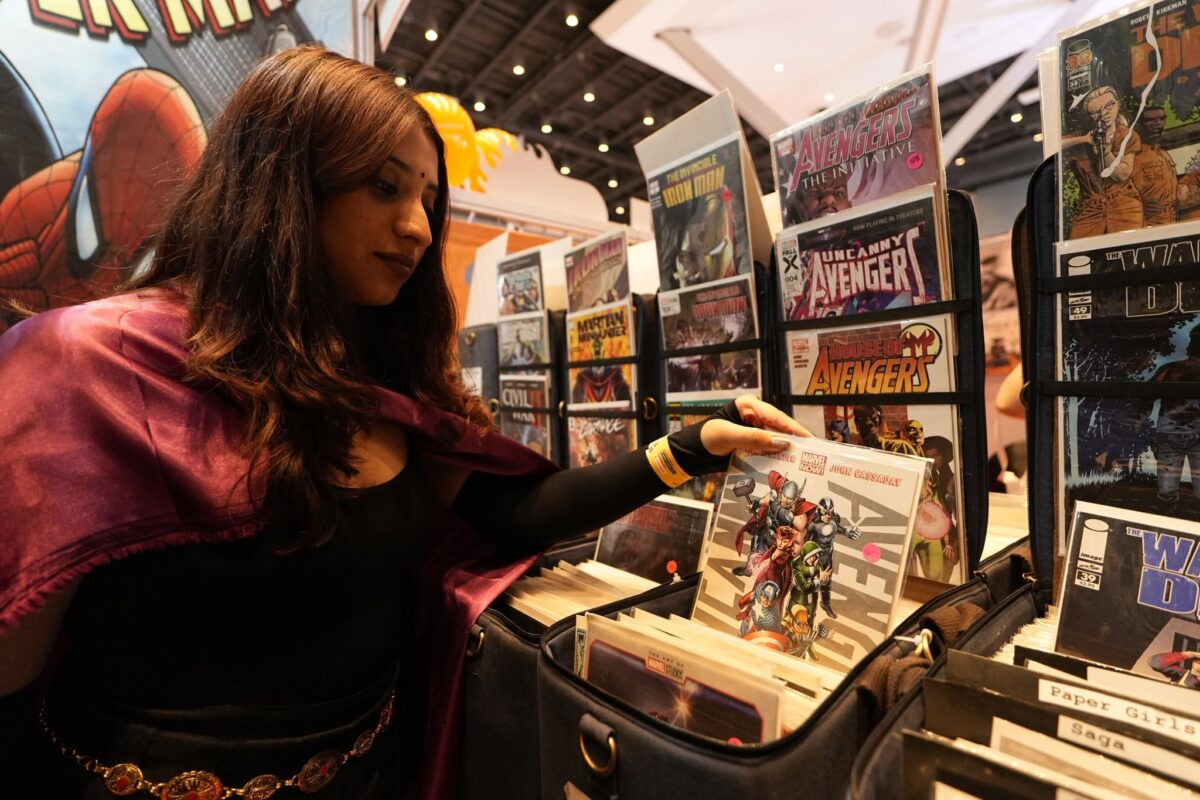
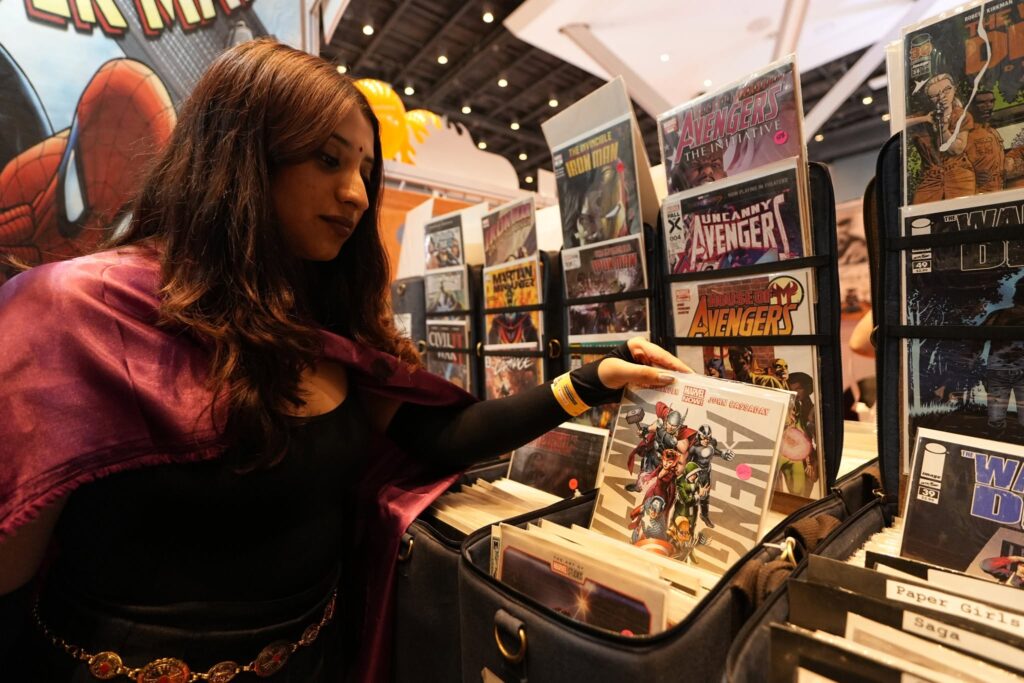
Comic conventions and independent-comics events have also become important parts of this ecosystem. For smaller creators, conventions can provide something that traditional retail distribution often cannot: direct access to readers.
A creator can display a self-published comic, talk to potential readers, collect feedback and sell copies without going through several layers of distribution. These events can also create connections between creators, publishers, artists and readers. For someone who is still building a career, meeting another creator or publisher at an event can sometimes be as valuable as selling copies.
This direct relationship changes the way comics can be discovered. Instead of finding a book only because it has a prominent position in a bookstore or because a major publisher has invested heavily in marketing it, readers can discover comics through conversations, creator tables, recommendations and online communities.
For the independent creator, that relationship can become the foundation of a long-term audience.
The Internet Has Changed the Equation
The growth of digital platforms has further reduced some of the traditional barriers to publishing. Social media can allow creators to show artwork, announce projects and communicate directly with readers. Webcomics can introduce characters and stories before a physical edition is produced, while crowdfunding platforms can help creators test whether an audience is willing to financially support a project.
Digital tools have also lowered the technical barrier to production. Lettering, page layout, editing and promotional design can be handled with software that was not easily available to independent creators in previous decades. Printing itself has also become more flexible, with smaller print runs making it possible to produce physical comics without necessarily committing to a huge initial quantity.
However, easier publishing does not automatically mean easier discovery. The same internet that gives creators access to global audiences also puts thousands of competing projects in front of those audiences. Independent creators therefore face a new problem: not simply producing a comic, but making sure readers can find it.
Original Ideas Still Need Visibility
One of the biggest challenges for independent comics is discoverability. A good comic can exist without receiving meaningful attention if it is buried beneath hundreds of other releases.
This is where comics journalism, reviews, creator interviews, conventions and specialist communities can make a difference. Independent work benefits from having spaces where readers can discover something beyond the biggest publishers and most heavily promoted franchises.
For comics websites and publications, covering independent creators is therefore more than simply filling a news category. It can become part of the industry’s documentation. A creator interview, review or profile can create a permanent record of a project that might otherwise disappear from public attention after its initial release.
The same applies to independent publishers. Their catalogues may contain important experiments, new characters and emerging talent, but those projects can remain invisible unless someone actively documents and discusses them.
India Has Its Own Opportunity
India’s comics ecosystem makes this discussion particularly relevant. The country has a long history of comics publishing, but the contemporary market includes a much wider range of creators and publishers than the names most commonly associated with Indian comics history.
Independent creators are working across genres, languages and formats, while smaller publishers and collectives are experimenting with new ways of producing and distributing comics. Social media and online communities have made it easier for these creators to find readers, but the market is still fragmented.
That fragmentation creates both a challenge and an opportunity. There is no single platform through which every Indian comics project is discovered. Readers may encounter a creator on Instagram, a publisher at a convention, a comic through an online store or a new release through word of mouth. Without consistent documentation, many of these projects can become difficult to find later.
A stronger ecosystem of comics journalism, reviews, interviews, databases and creator profiles can help connect these separate parts of the industry.
Independent Does Not Automatically Mean Better
It is also important not to romanticize independent comics. Being independent does not automatically make a comic more creative, more original or better than a commercially published book. Independent creators can produce excellent work, but they can also produce work that suffers from weak editing, inconsistent artwork, production problems or limited storytelling experience.
The value of independent comics lies more in the opportunities they create than in an assumption that every independent project is superior. They expand the range of voices and ideas available to readers. Some projects will succeed commercially, some will remain niche, and others may simply serve as important learning experiences for their creators.
That variety is healthy for the medium because experimentation often happens at the edges before it becomes part of the mainstream.
The Future May Be More Connected Than Divided
The relationship between independent and mainstream comics is not necessarily a competition in which one side must replace the other. In reality, creators frequently move between different parts of the industry. An artist may begin with self-published work, collaborate with a small publisher and eventually work on a major licensed property. Another creator may spend years in mainstream comics before returning to creator-owned projects.
These movements show that the comics industry is not made up of completely separate worlds. Ideas, creators and audiences move between them.
Independent comics therefore remain important because they provide space for experimentation, new talent and original intellectual property. They also give readers opportunities to discover stories that would be unlikely to appear through the most commercially predictable publishing routes.
In a crowded comics market, that diversity matters. The future of comics will not be shaped only by the largest publishers or the biggest characters. It will also be shaped by creators working with limited resources, small publishers taking calculated risks and readers willing to look beyond the most visible releases.
For the comics industry to grow, those smaller voices need not replace the mainstream. They simply need enough space to be seen, read, discussed and remembered.
Delhi Comic Con 2026 is scheduled for December 5 and 6 at the NSIC Exhibition Grounds in Okhla, Delhi, with Indian comics publishers, creators and visual storytellers included among the event’s announced participants.
According to the official Comic Con India website, the Delhi edition will feature Indian names including Bullseye Press, Holy Cow Entertainment, Yali Dream Creations, Urban Tales, Studio Kapi and artist Saumin S. Patel.
The event will also include the wider pop-culture programming associated with Comic Con India, including cosplay, gaming, merchandise, celebrity appearances and interactive experiences.
For the Indian comics industry, however, the publisher and creator presence is one of the more interesting parts of the upcoming event.
Indian Comics at a Large Pop-Culture Event
Comic Con India has developed into a large multi-format pop-culture event rather than a convention focused exclusively on comic books.
That means comics now share the same physical space with films, television, gaming, cosplay, merchandise and other forms of entertainment.
This can create both opportunities and challenges for publishers.
The opportunity is obvious: comics creators can reach an audience that may not regularly visit specialist comic shops or follow comics websites.
The challenge is equally clear.
A comic book is competing for attention with dozens of other forms of entertainment.
For smaller publishers, therefore, simply having a presence at a large convention can be valuable.
Bullseye Press
Bullseye Press is listed among the Indian guests for Delhi Comic Con 2026. Comic Con India describes the publisher as an Indian comic publisher known for bilingual storytelling.
The inclusion of a publisher working across languages is particularly relevant in the Indian market.
India does not have one uniform comics audience.
Readers consume comics in English and multiple Indian languages, while different generations have grown up with different publishing traditions.
Bilingual and multilingual publishing can therefore offer publishers another way to reach readers.
Holy Cow Entertainment
Holy Cow Entertainment is another announced Indian comics publisher.
Comic Con India’s official listing describes Holy Cow as a veteran comic-book publisher behind more than 80 titles, including Ravanayan, The Aghori and The Last Asuran.
The publisher’s presence is notable because it represents a long-running part of India’s modern comics publishing landscape.
Events such as Comic Con give publishers the opportunity to put physical books directly in front of readers.
That physical interaction remains important even as digital discovery becomes increasingly common.
Yali Dream Creations and Newer Publishing Voices
Yali Dream Creations is also listed as an Indian graphic-novel publisher, with Comic Con India describing the company as working across genres and focusing on immersive storytelling.
Its inclusion alongside more established publishers demonstrates the variety within India’s current comics ecosystem.
The Indian comics industry is not limited to one publishing model.
There are established publishers, independent creators, graphic-novel studios, small presses and creator-led projects operating simultaneously.
A convention provides a place where readers can encounter these different models in the same environment.
Why Physical Events Still Matter
The rise of social media and online shopping has changed comics discovery.
A reader can now learn about a comic through Instagram, YouTube, X, a publisher’s website or an online marketplace without ever visiting a physical event.
Yet conventions offer something digital platforms cannot completely reproduce: direct interaction.
A creator can talk to a reader about a character.
An artist can show original artwork.
A publisher can explain how a book was produced.
A reader can discover a title simply because it was sitting on a table.
For independent comics, those interactions can be particularly important.
Delhi’s Role
Delhi is also an important location for the Indian publishing and comics ecosystem.
The capital has a large book-buying audience, universities, cultural institutions, publishing companies and a substantial convention-going community.
Holding Comic Con at the NSIC Exhibition Grounds gives publishers a major physical venue for reaching that audience.
The official event listing currently places Delhi Comic Con on December 5–6, while the Comic Con India ticketing page lists single-day passes from ₹1,199 and other pass options.
More Than a Fan Event
The most interesting question surrounding Delhi Comic Con 2026 is not simply how many people attend.
It is what happens when those attendees encounter Indian comics.
A successful convention appearance can lead to direct sales, new readers, social-media followers, creator collaborations and future opportunities.
For publishers, the event can therefore function as a marketing and distribution channel.
For creators, it can become a networking opportunity.
For readers, it can act as a discovery platform.
And for the broader Indian comics industry, the presence of multiple publishers under one roof provides a visible snapshot of the current ecosystem.
Delhi Comic Con 2026 is still several months away, and Comic Con India says more updates are coming.
As additional guests, exhibitors and programming are announced, the event could provide an increasingly useful picture of where India’s contemporary comics and graphic storytelling scene is heading.
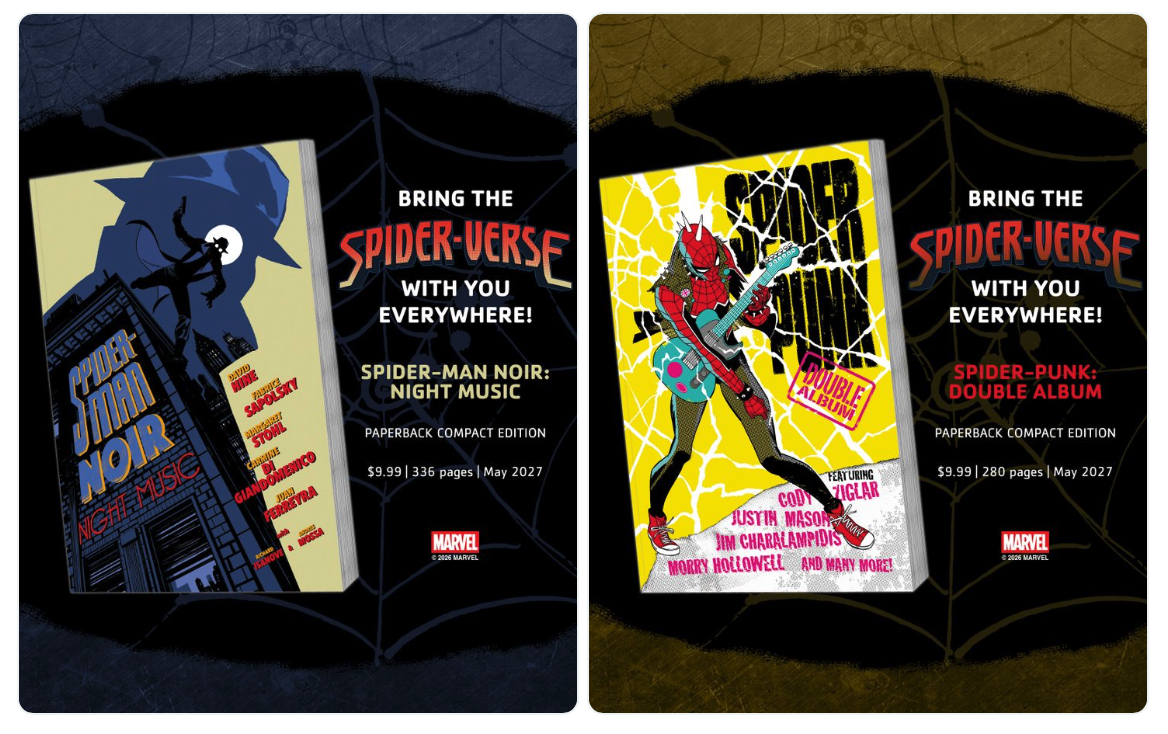
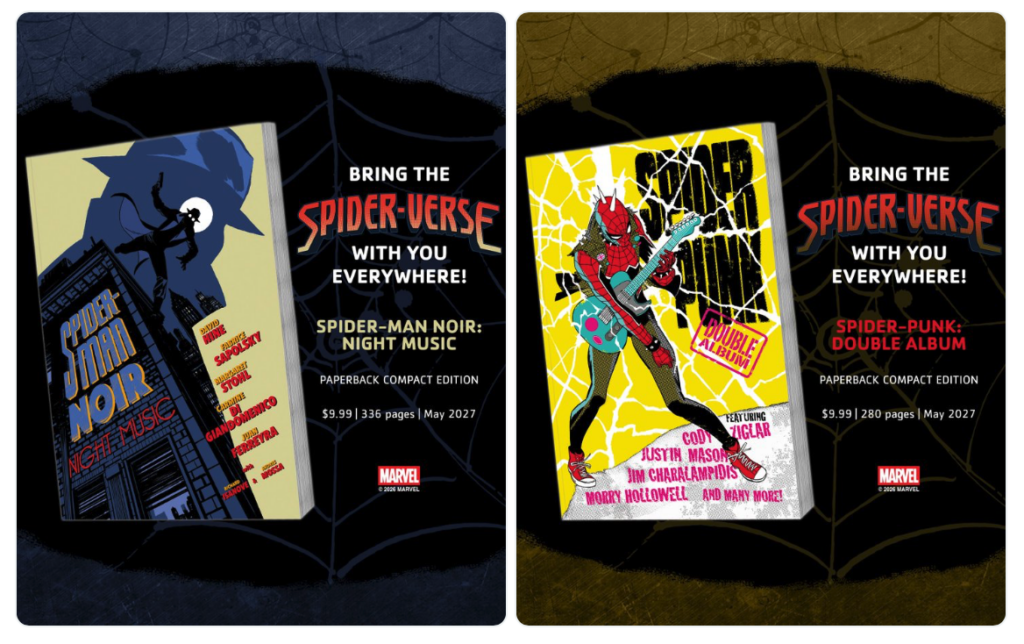
Marvel is expanding its Compact Comics publishing initiative with new volumes centred on Spider-Man Noir and Spider-Punk, adding two alternate versions of Spider-Man to a format designed to make selected stories more accessible to readers.
The new books were reported on September 25, 2026, as Marvel continues to expand its budget-friendly Compact Edition line. The initiative has focused on collecting stories in smaller-format trade paperbacks, giving readers another way to access material from Marvel’s extensive catalogue.
At first glance, another collection of Spider-Man stories may not appear particularly unusual. Marvel publishes a huge number of Spider-Man books every year.
But the Compact Edition strategy is interesting because of what it says about the modern comics market.
The Problem of a Huge Back Catalogue
One of the biggest advantages of a company such as Marvel is also one of its biggest challenges.
There is an enormous amount of material available.
Spider-Man alone has decades of stories, multiple ongoing series, alternate universes, crossover events and different interpretations of the character.
For an existing reader, that history can be exciting.
For a new reader, it can be intimidating.
Where should someone start?
Which stories are important?
Does a reader need to understand years of continuity before opening a particular collection?
Publishers have experimented with different solutions to this problem, including new #1 issues, relaunches, collected editions and simplified entry points.
Compact Editions represent another approach.
Why Spider-Man Noir?
Spider-Man Noir is particularly suited to a collection strategy because the character already exists as a distinct interpretation of Spider-Man.
The Noir version moves the familiar concept into a darker alternate setting. Instead of simply presenting another Peter Parker adventure within the mainstream Marvel universe, the character operates within a different aesthetic and storytelling framework.
That makes the material easier to market as its own experience.
A reader does not necessarily need to begin with decades of mainstream Spider-Man comics.
The same applies to Spider-Punk.
Spider-Punk and the Multiverse Audience
Spider-Punk represents another direction for the Spider-Man concept.
The character became widely recognisable through the larger Spider-Verse phenomenon, which introduced audiences to multiple versions of Spider-Man and demonstrated how flexible the central concept could be.
That flexibility is valuable to Marvel.
Instead of relying entirely on one version of the character, the company can publish stories built around different interpretations, aesthetics and audiences.
The result is a Spider-Man publishing line that can include traditional superhero stories alongside alternative versions of the character.
Compact Editions as an Entry Point
The most interesting part of Marvel’s Compact Edition strategy may be its potential relationship with new readers.
Comics publishers face a recurring problem: the medium has an enormous history, but that history can create barriers to entry.
A new reader does not necessarily want to purchase dozens of individual issues before understanding a story.
Collected editions solve part of that problem.
A compact, relatively inexpensive collection can make the decision easier.
Instead of asking:
“Where do I start with Spider-Man?”
a reader can simply choose a character or story that looks interesting.
That changes the role of the collected edition.
It becomes not just a product for existing fans but potentially an introduction to the medium.
The Importance of Format
Format matters more than it sometimes appears.
Readers have different preferences for individual issues, standard trade paperbacks, hardcovers, digital editions and compact collections.
A publisher that offers several formats can reach different groups without necessarily changing the underlying content.
Marvel’s Compact Editions therefore form part of a broader publishing strategy rather than simply being another collection line.
The question is whether the format can successfully convert curiosity into regular readership.
What It Means for Comics Publishers
The strategy also has implications beyond Marvel.
Indian publishers and independent comics creators face a similar challenge, although at a different scale.
A reader may be interested in a new character but hesitate to spend money on an unfamiliar series.
A clearly packaged first volume, affordable edition or self-contained story can reduce that barrier.
This is particularly relevant for indie comics, where discoverability is often one of the biggest challenges.
The Marvel example shows how publishers can use format and packaging to make a large catalogue easier to navigate.
A Different Way to Think About Marvel’s Catalogue
Marvel’s biggest asset is not simply the number of characters it owns.
It is the number of different stories that can be built around those characters.
Spider-Man Noir and Spider-Punk demonstrate how far the basic Spider-Man concept can travel.
The Compact Comics initiative adds another layer to that strategy by changing how readers encounter those stories.
Whether readers choose Noir, Spider-Punk, mainstream Spider-Man or another Marvel character, the underlying publishing objective remains familiar: make the catalogue easier to discover and give readers a reason to pick up another book.
For a company with one of the largest comic-book libraries in the world, that is an ongoing publishing challenge.
The expansion of the Compact Edition line suggests Marvel is continuing to experiment with how that library can reach readers.
Rebellion has sold Solaris, its science-fiction, fantasy and horror publishing imprint, to Profile Books in a move that brings one of the better-known specialist genre imprints under new ownership.
The deal was reported on September 25, 2026, with Rebellion confirming the sale of Solaris to Profile Books. Rebellion is best known in comics for publishing 2000 AD and Judge Dredd, but the company has also operated a broader publishing business that includes books across science fiction, fantasy and horror.
For readers who primarily know Rebellion through comics, the transaction is nevertheless worth watching because Solaris has developed an identity of its own within genre publishing.
What Is Solaris?
Solaris is a publishing imprint focused primarily on science fiction, fantasy and horror. Its catalogue has included novels and other genre fiction, allowing Rebellion to operate beyond the traditional comics publishing model.
That distinction is important.
Modern comics companies increasingly operate across several forms of storytelling. A publisher may begin with comics, develop relationships with creators and readers, and eventually move into novels, television, film, games or other formats. Rebellion itself is an example of a company whose publishing interests extend beyond the monthly comics traditionally associated with 2000 AD.
Solaris therefore represents a different part of Rebellion’s publishing operation.
The sale does not mean that Rebellion is leaving publishing. Instead, it transfers ownership of one particular imprint to Profile Books.
Why Profile Books?
Profile Books is an independent UK publisher with a broad publishing programme. Bringing Solaris into the Profile Books group gives the imprint a new corporate home while potentially allowing it to continue developing its existing genre identity.
For readers, the most immediate question is what happens to the books and creators already associated with Solaris.
A change in ownership does not necessarily mean an immediate change in the identity of an imprint. Publishing companies frequently acquire established imprints precisely because those imprints already possess a recognisable audience, editorial history and catalogue.
The value is therefore not simply the name on the corporate paperwork.
It is the accumulated relationship between the imprint, its authors, its booksellers and its readers.
What This Means for Rebellion
Rebellion’s decision also provides an interesting look at how specialist publishers manage their catalogues.
Operating several publishing lines requires editorial resources, sales infrastructure, marketing and distribution. A company may decide that a particular imprint can have a stronger future under a different owner while it concentrates on its core areas.
Rebellion remains closely identified with 2000 AD, Judge Dredd and the wider British comics tradition.
That makes the Solaris sale particularly interesting from a comics-industry perspective.
It demonstrates that even companies with strong genre publishing identities may periodically restructure their operations.
The Bigger Publishing Picture
The publishing industry has changed considerably over the past decade.
Genre audiences are no longer neatly separated into comics readers, novel readers, film audiences and game players. A single property can exist across several formats, while readers increasingly discover stories through different media.
That creates opportunities for publishers, but it also makes publishing businesses more complicated.
A specialist imprint needs a clear identity. It must attract creators, reach readers and maintain enough visibility to compete for attention in a crowded marketplace.
Solaris already has that identity.
The new ownership therefore gives Profile Books an established genre imprint rather than requiring it to build one from scratch.
What Happens Next?
The immediate future of Solaris will be worth following through its upcoming publishing announcements, creator relationships and catalogue decisions.
For readers, the most useful indicator will not simply be the ownership change itself. It will be whether Solaris continues to publish the type of science-fiction, fantasy and horror books that established its audience.
For the wider comics and genre publishing industry, the transaction is another example of how specialist publishing businesses evolve.
Rebellion’s connection with 2000 AD and Judge Dredd remains one of the company’s defining characteristics, while Solaris now enters a new chapter under Profile Books.
The deal is therefore less about the disappearance of an imprint and more about a change in who controls its next stage of publishing.
And for an industry built around long-running creative properties, catalogues and specialised audiences, that distinction matters.
Indian comic books and graphic novels have officially outgrown the historical stereotype of being mere “children’s entertainment.” Today, the Indian sequential art landscape is undergoing a structural renaissance. A sophisticated wave of independent creators, micro-publishers, and graphic novelists are crafting mature, socio-politically conscious, and visually experimental narratives. From mythological subversions to grit-heavy noir, the modern Indian comic book is a serious literary and artistic discipline.
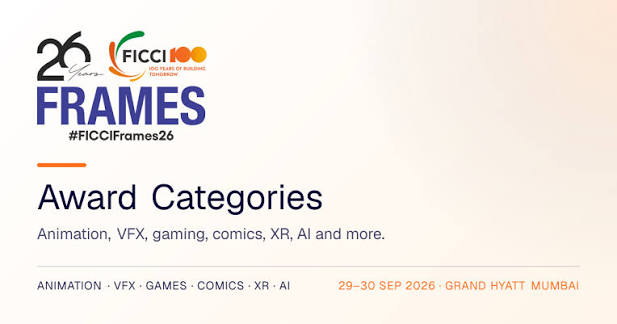
When major institutional entities take notice of this evolution, it is universally viewed as a step forward. The inclusion of dedicated sequential art categories at national-level platforms is a testament to this shift. A prime example is the upcoming FICCI Best Animated Frames (BAF) Awards 2026, scheduled to culminate in a grand ceremony on 29 September 2026 at the Grand Hyatt in Mumbai. For an industry that has long survived on raw intent rather than mass commercial scale, being spotlighted by the Federation of Indian Chambers of Commerce and Industry (FICCI) is a massive victory.
However, institutional validation comes with infrastructural responsibility. As highlighted in a sharp critique published by the vernacular comic-journalism portal ComicsLeLo, a foundational issue threatens the credibility of these awards. While the inclusion of specialized categories like Best Comics/Graphic Novel, Best Comics Writer, Best Comics Artist, Best Comics Colorist, and Best Cover is commendable, it exposes an underlying flaw: The apparent lack of domain-specific comic book experts on the central judging panel.
This missing element raises critical questions about transparency, metric evaluation, and the widening systemic gap between mainstream media conglomerates and independent sub-cultures.
The Anatomy of Sequential Art vs. The Screen Lens
To understand why the comic book community is raising its voice, one must look at the artistic architecture of a comic book. Comics are not merely static movies, nor are they simply illustrated short stories. They exist as an autonomous medium governed by strict, highly specific technical rules—a medium famously categorized by theorist Will Eisner as Sequential Art.
According to publicly accessible structural outlines from the FICCI BAF Awards, the central evaluation panel comprises seven core members tasked with reviewing submissions across multiple expansive domains: Animation, VFX, Video Games, Extended Reality (XR), Artificial Intelligence (AI), and Comics.
While a veteran animation director, a blockbuster VFX supervisor, or a veteran video game developer possesses undeniable mastery over visual storytelling, character design, and structural pacing, their professional training is fundamentally optimized for the screen, not the page.
When a multi-disciplinary jury reviews a graphic novel, they inadvertently tend to evaluate it through a cinematic lens. This creates a severe evaluating misalignment. Comic books operate on silent, static mechanics that have no direct translation in film or animation:
Panel Layout & Geometry: In film, the screen aspect ratio is uniform. In comics, the layout of the panels is dynamic. The shape, size, and positioning of a panel dictate the passing of time, emotional weight, and psychological tension. A panel is an artistic choice in itself, not just a window.
The Gutter and Pacing: The white space between panels—known as the “gutter”—is where the true magic of comic book reading happens. The reader’s mind actively bridges the gap between two static images to create closure. Measuring visual pacing across static pages requires an entirely different metric than evaluating the frames-per-second timing of an animation reel. [2]
Lettering and Graphic Integration: Typography in comics is not a post-production afterthought. The placement of dialogue balloons, the choice of fonts, and the design of hand-drawn sound effects directly control how a reader’s eye moves across a page.
Color Scripting for Print: A comic colorist works with entirely different color profiles, print bleeding standards, and paper textures compared to a digital colorist rendering VFX passes for an IMAX screen or light-mapping assets for an Unreal Engine game engine.
Evaluating a comic book writer’s script based on traditional screenplay structures ignores the realities of writing for sequential panels. Without an expert who understands how a script transforms into sequential art, an award panel risks celebrating books that “look like movies” rather than books that excel at being comics.
The Risk of Institutional Superficiality
When mainstream bodies include alternative mediums within their existing frameworks without integrating actual members of those sub-cultures, it creates an ongoing state of institutional isolation.
The FICCI BAF Awards have historically built their legacy on the shoulders of the Indian AVGC (Animation, Visual Effects, Gaming, and Comics) sector. However, within the AVGC umbrella, the letter ‘C’ (Comics) has frequently played the role of an overlooked sibling. Animation and VFX pull in corporate investments and massive studio pipelines; gaming commands aggressive venture capital and user-monetization matrices. Comics, by contrast, remain heavily reliant on grassroots creators, boutique indie publishers, and self-funded passion projects.
By leaving the final verdict of specialized comic categories entirely to a centralized general jury panel, the system defaults to a baseline of superficiality. An animation-heavy jury might inadvertently judge an entry based purely on high-fidelity illustration work, missing flaws in panel transitions or sequential legibility. Conversely, an indie book with minimalist, highly stylized indie artwork that uses master-level panel transitions might be completely dismissed because it lacks the glossy, commercial aesthetic that visual effects experts are trained to look for. [2]
This structurally disadvantages the independent comic community. Independent creators do not have access to large studio budgets or massive production pipelines. Their strength lies in pushing the boundaries of the printed medium. If the people evaluating their work do not possess the historical or technical literacy of the comic book industry, the awards risk losing relevance among the very creators they aim to honor.
A Matter of Structural Transparency
As ComicsLeLo’s editorial highlights, this critique is not an attack on the individual capabilities or professional stature of the current jurors. The seven-member panel undoubtedly features pioneers who have shaped India’s digital entertainment frontiers. Rather, it is an argument regarding the lack of structural transparency and specialization in national award systems. [2]
For any institutional award to command absolute authority, the judging process must be transparent. The comic book community deserves clarity on two crucial operational parameters:
Category Allocation: Did all seven multi-disciplinary jury members evaluate every single submission across all 39 sub-categories, or was there a specialized division of labor?
Evaluation Metrics: What specific guidelines were provided to evaluate the comic book submissions? Were there distinct scoring sheets for lettering, cover design, and panel sequencing, or were they grouped under generic headers like “Best Visual Design” or “Best Narrative Structure”?
If a national sports award panel tasked with judging wrestling, cricket, and chess consisted entirely of legendary cricket commentators and stadium curators, the chess community would naturally express concern—not because they doubt the achievements of the cricketers, but because the technicalities of chess require a chess master’s eye. The same operational logic applies to sequential art.
The Path Forward: Decentralization and Co-Opting Industry Voices
If platforms like FICCI BAF wish to cement their positions as definitive arbiters of excellence in the Indian comic space, they must evolve from a centralized judging model to a decentralized, specialized framework. The solutions are straightforward and have been successfully executed by historic global entities like the Eisner Awards, the Harvey Awards, and the Angoulême International Comics Festival.
1. Form a Sub-Jury for Sequential Art
The most immediate fix is the creation of a specialized sub-committee or sub-jury dedicated entirely to the comic book categories. This panel should consist of veteran Indian comic book writers, independent publishers, legendary illustrators, sequential art academics, and recognized comic book journalists. The main jury can still oversee the final proceedings, but the shortlisting and technical evaluation should be driven entirely by domain experts.
2. Collaborate with Grassroots Industry Bodies
Organizations like the Indian Comics Association (ICA) or curation teams behind indie platforms like the Indie Comix Fest should be consulted to recommend qualified jurors. Bridging the gap between corporate trade associations like FICCI and grassroots comic unions ensures that the judging panel reflects the actual realities of the ground-level ecosystem.
3. Publish Judging Standards and Points Breakdowns
To build long-term trust, award bodies should publicly release their evaluation scorecards. Knowing that an entry will be judged specifically on panel flow, narrative pacing, graphic lettering integration, and color execution will encourage creators to elevate their technical standards, raising the benchmark for the entire domestic industry.
Conclusion: Respecting the Canvas
The inclusion of comic books at the FICCI BAF Awards 2026 is an encouraging milestone that proves the medium can no longer be ignored by mainstream media decision-makers. It is an acknowledgment that sequential art is a pillar of India’s creative economy.
However, true validation requires deep, unconditional respect for the unique technicalities of the medium. You cannot celebrate the evolution of Indian comics while utilizing an evaluation system that treats them as a secondary branch of animation pre-production. For these awards to achieve genuine cultural equity, the judging panel must change. It is time to diversify the room, open up the parameters, and bring actual comic book specialists to the jury table. Only then will national recognition truly match the artistic intent and hard work of India’s independent creators.